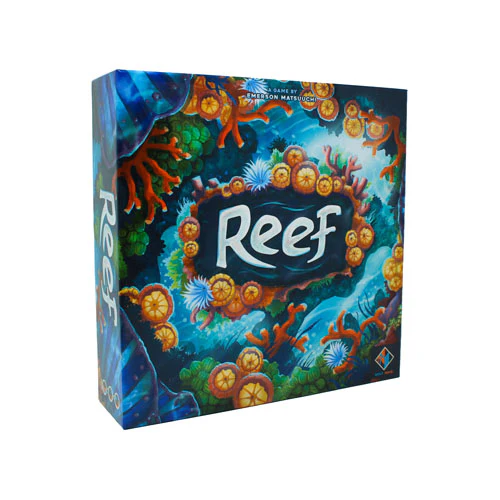
Reef
Reef is a game from Next Move Games, a game studio founded to bring out accessible games that all seemingly are named four letter words, albeit socially acceptable ones. The first of these was the phenomenally successful Azul. Can Reef prove even more popular?
On the face of it Reef is a simple game, on your turn you will either play a card from your hand or draw a card from a selection of four available. Each card you play will allow you to add two coral pieces to your reef, shown on the top half, and maybe score your reef, shown on the bottom half. The coral pieces are chunky plastic in four different colours and stack pleasingly on each other. Each tower can be up to four coral high and you are free to mix colours as you wish. You must remember two key rules, however, firstly only the top most colour counts for scoring, and secondly you can never remove any coral from your reef.
Why is this important? Because the second thing you can do when you play a card is to score the pattern on the bottom half. This will dictate how coral should be arranged and at what height to varying degrees of complexity. You can score each pattern multiple times if you plan wisely, but often you may have to not score a card at all, in order to plan for a future turn.
This creates a neat tension between grabbing cards that give you coral to build towards bigger scores, and potentially wasting the scoring potential of those cards, and trying to choose cards that will score every time you play them.
Of course, added to this is the fact that everyone else is trying to do the same thing, and may want the same card or cards that you do. Or perhaps they are just aiming for a massive payoff and you are need to stop them!
The cleverness of the scoring makes the game a lot more brain burning than the pretty components seem, meaning this is a great game for new and experienced players alike. It's easier to explain than Azul, yet perhaps with a touch more depth.
Similar to Azul this is a very pretty abstract game, but I'd argue that Reef attempts to embrace its admittedly light theme a touch more than Azul does. They both look great though, and help the promote abstract games as more than dry, boring, head to heads that last hours.
Player Count: 2-4
Time: 35-45 Minutes
Age: 8+
Reef is a game from Next Move Games, a game studio founded to bring out accessible games that all seemingly are named four letter words, albeit socially acceptable ones. The first of these was the phenomenally successful Azul. Can Reef prove even more popular?
On the face of it Reef is a simple game, on your turn you will either play a card from your hand or draw a card from a selection of four available. Each card you play will allow you to add two coral pieces to your reef, shown on the top half, and maybe score your reef, shown on the bottom half. The coral pieces are chunky plastic in four different colours and stack pleasingly on each other. Each tower can be up to four coral high and you are free to mix colours as you wish. You must remember two key rules, however, firstly only the top most colour counts for scoring, and secondly you can never remove any coral from your reef.
Why is this important? Because the second thing you can do when you play a card is to score the pattern on the bottom half. This will dictate how coral should be arranged and at what height to varying degrees of complexity. You can score each pattern multiple times if you plan wisely, but often you may have to not score a card at all, in order to plan for a future turn.
This creates a neat tension between grabbing cards that give you coral to build towards bigger scores, and potentially wasting the scoring potential of those cards, and trying to choose cards that will score every time you play them.
Of course, added to this is the fact that everyone else is trying to do the same thing, and may want the same card or cards that you do. Or perhaps they are just aiming for a massive payoff and you are need to stop them!
The cleverness of the scoring makes the game a lot more brain burning than the pretty components seem, meaning this is a great game for new and experienced players alike. It's easier to explain than Azul, yet perhaps with a touch more depth.
Similar to Azul this is a very pretty abstract game, but I'd argue that Reef attempts to embrace its admittedly light theme a touch more than Azul does. They both look great though, and help the promote abstract games as more than dry, boring, head to heads that last hours.
Player Count: 2-4
Time: 35-45 Minutes
Age: 8+
Original: $36.79
-65%$36.79
$12.88Description
Reef is a game from Next Move Games, a game studio founded to bring out accessible games that all seemingly are named four letter words, albeit socially acceptable ones. The first of these was the phenomenally successful Azul. Can Reef prove even more popular?
On the face of it Reef is a simple game, on your turn you will either play a card from your hand or draw a card from a selection of four available. Each card you play will allow you to add two coral pieces to your reef, shown on the top half, and maybe score your reef, shown on the bottom half. The coral pieces are chunky plastic in four different colours and stack pleasingly on each other. Each tower can be up to four coral high and you are free to mix colours as you wish. You must remember two key rules, however, firstly only the top most colour counts for scoring, and secondly you can never remove any coral from your reef.
Why is this important? Because the second thing you can do when you play a card is to score the pattern on the bottom half. This will dictate how coral should be arranged and at what height to varying degrees of complexity. You can score each pattern multiple times if you plan wisely, but often you may have to not score a card at all, in order to plan for a future turn.
This creates a neat tension between grabbing cards that give you coral to build towards bigger scores, and potentially wasting the scoring potential of those cards, and trying to choose cards that will score every time you play them.
Of course, added to this is the fact that everyone else is trying to do the same thing, and may want the same card or cards that you do. Or perhaps they are just aiming for a massive payoff and you are need to stop them!
The cleverness of the scoring makes the game a lot more brain burning than the pretty components seem, meaning this is a great game for new and experienced players alike. It's easier to explain than Azul, yet perhaps with a touch more depth.
Similar to Azul this is a very pretty abstract game, but I'd argue that Reef attempts to embrace its admittedly light theme a touch more than Azul does. They both look great though, and help the promote abstract games as more than dry, boring, head to heads that last hours.
Player Count: 2-4
Time: 35-45 Minutes
Age: 8+